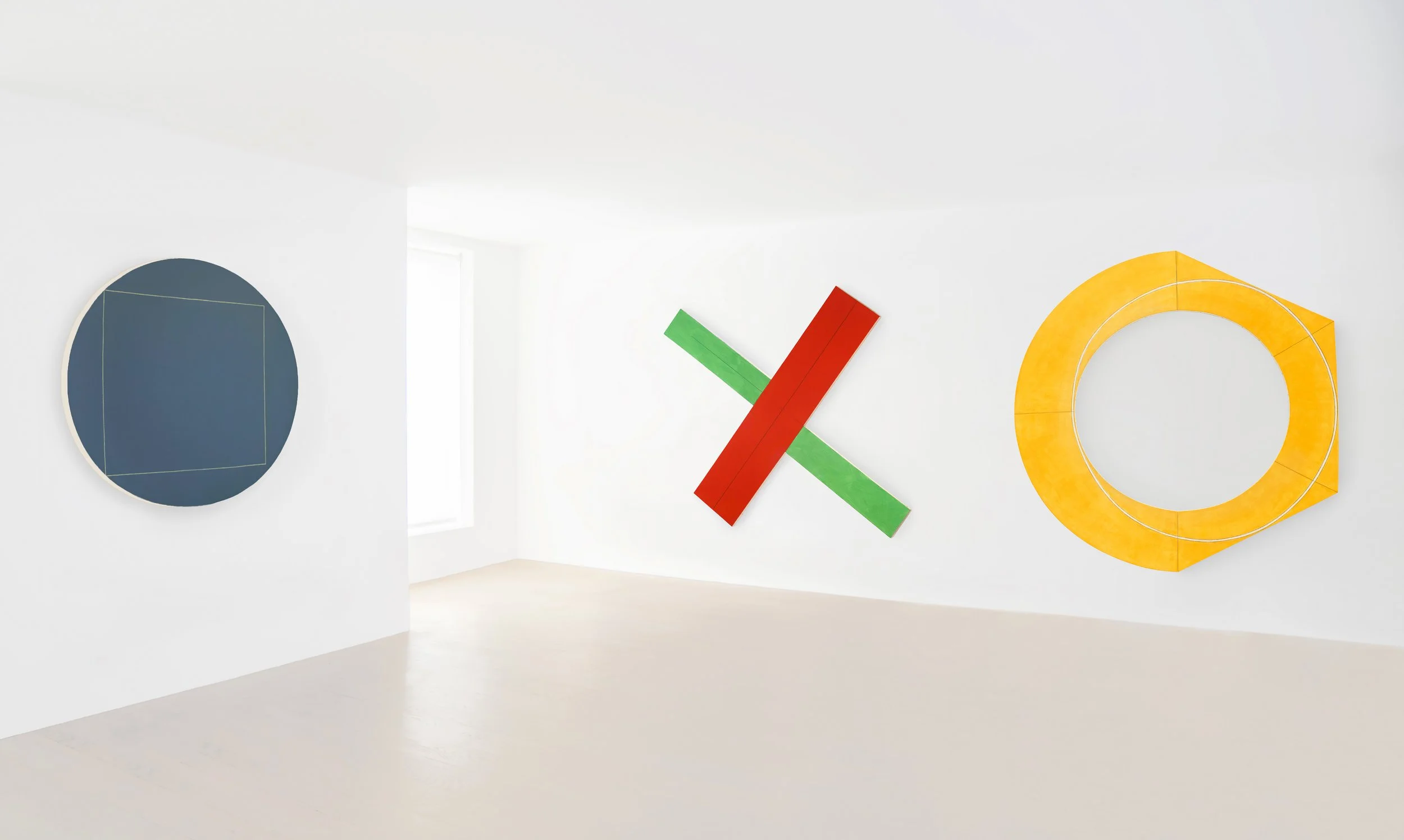
Robert Mangold | Paintings 1973-2012
April 22 - August 14, 2026
"I saw my painting neither as Painting as Window/Illusion nor Painting as Object. This flat, altered shape, picture plane, existing before you like a wall, that you could neither enter nor treat as an object, was Painting's essence. Painting you relate to like architecture in a scale related to human size." - Robert Mangold
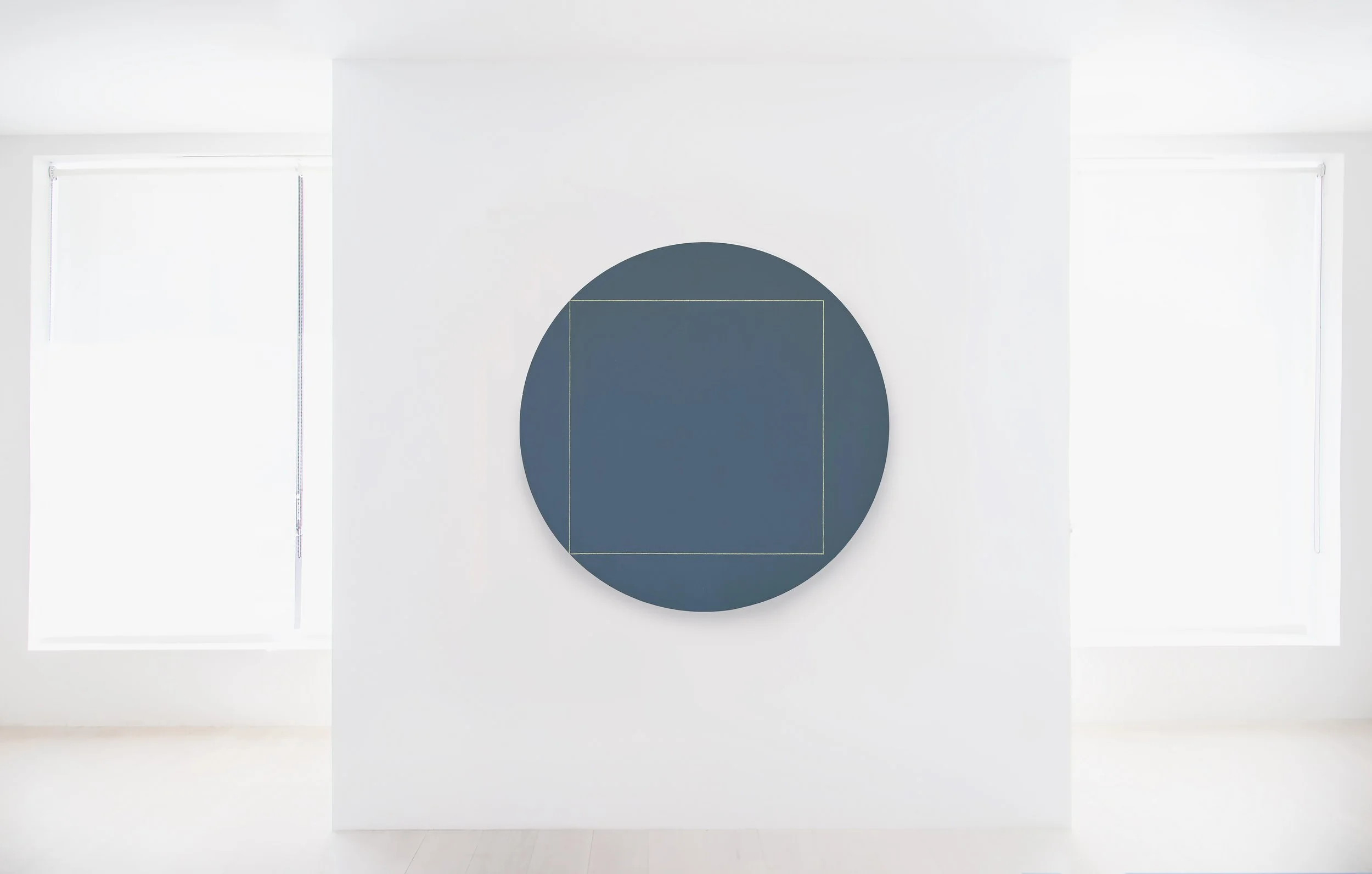
NEW YORK, NY – Robert Mangold’s paintings are investigations. Across more than five decades, he has returned to a focused set of concerns—line, color, shape, and structure—testing their relationships through a sustained and deliberate practice. The works in this exhibition, spanning from 1973 to 2012, reflect both continuity and variation. While they differ in format, scale, and composition, each holds to a consistent intent: to explore how a painting can exist as a complete and self-contained object.
Mangold’s early work emerged in dialogue with the spatial clarity of Barnett Newman and the chromatic restraint of Mark Rothko, while drawing on forms and colors from the built environment. From the outset, he rejected gesture and illusion in favor of a measured approach. “The idea of a very flat work was where my interests lay,” he noted. “It was almost against the trend of things… painting was becoming something else… either sculpture or theater.” Against this, Mangold insisted on painting as painting—flat, direct, and specific.
This position remains central throughout his career. His paintings are built through a methodical process of drawing and revision, often beginning with scaled studies that establish the structure in advance. The surfaces are composed of thin layers of acrylic, producing fields of muted color that hold the presence of the hand without emphasizing it. Line is drawn, not expressive, but deliberate—cutting across, interrupting, or aligning with the edges of the canvas. Color and line are treated as distinct elements, brought into relation only through the act of painting.
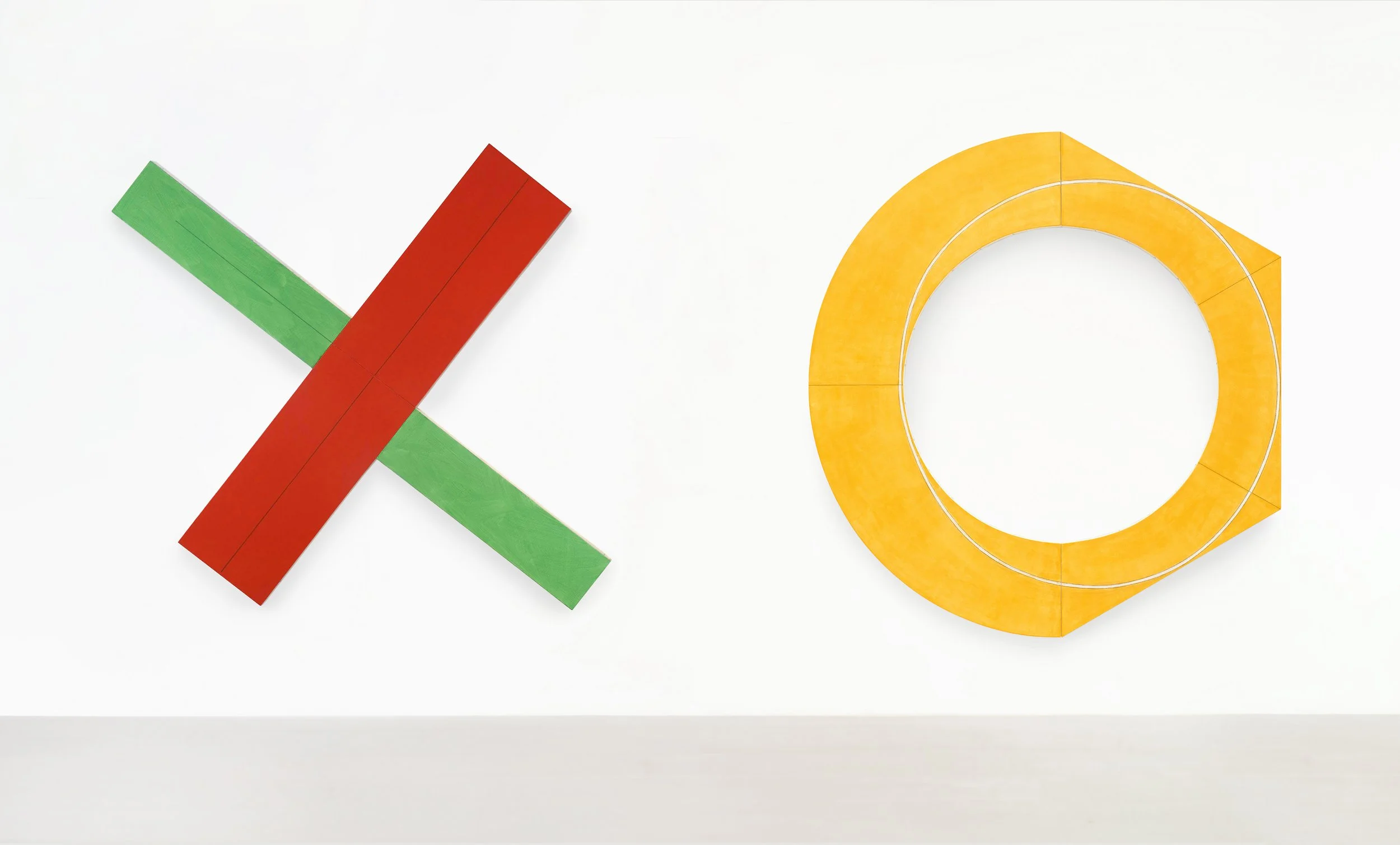
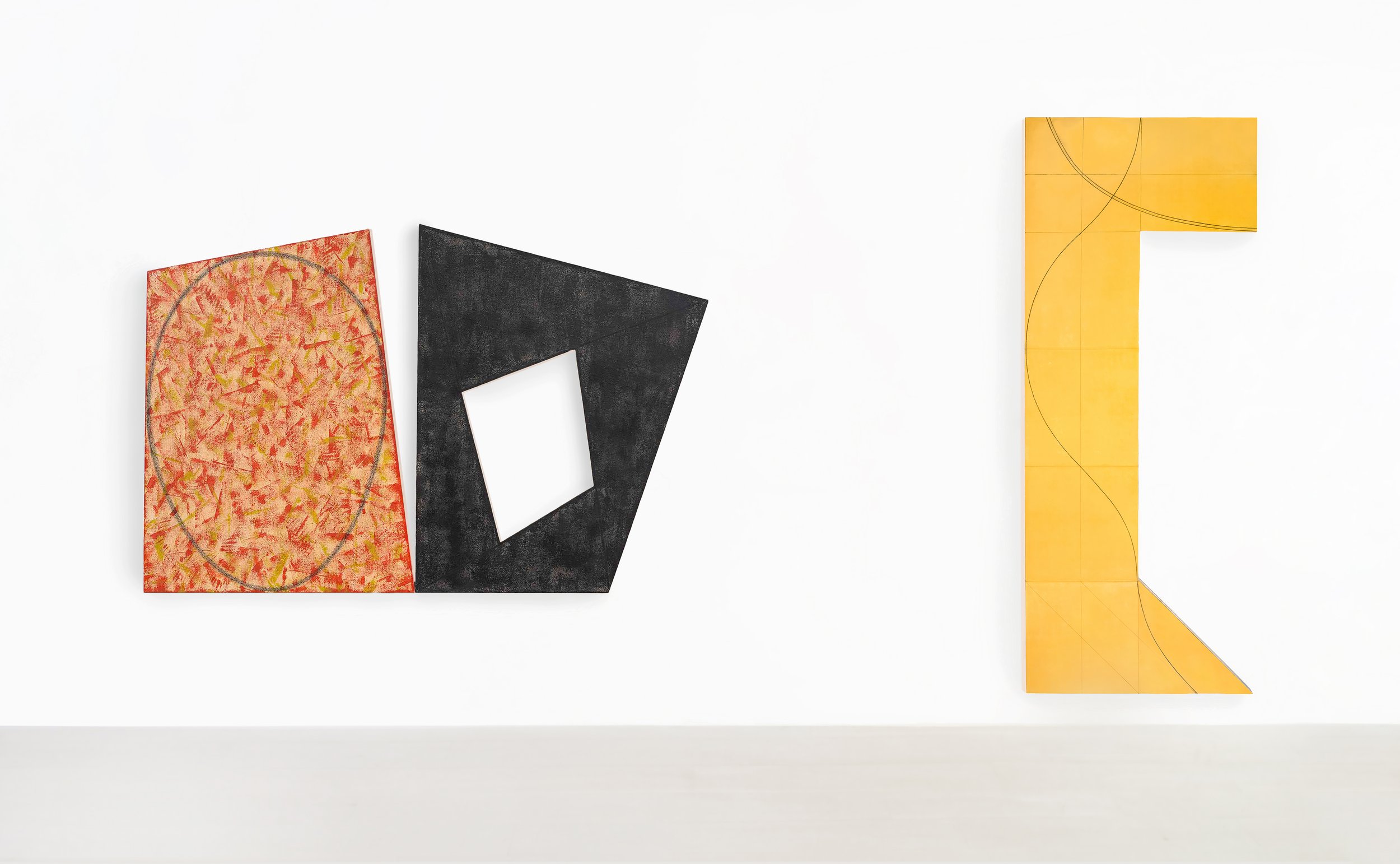
Over time, Mangold’s work continued to develop, and by the 2000s his paintings became more open and fragmented. In Column Structure XIII A (2007), verticality and undulating linear elements establish a rhythm that feels both architectural and in motion. Compound Ring II Variant (White Line) (2012) extends his earlier investigation into circular forms, introducing an “empty center” that becomes an active component of the composition. As Mangold noted, “One of the things I like about the empty center is that you have to deal with it. It becomes a very physical expression of the body’s limits.” Here, absence is not a void, but a condition that shapes how the painting is seen and understood.
Throughout these works, the physical structure of the painting is integral. Multi-panel compositions emphasize the seams between canvases, while shaped supports and apertures disrupt the expected rectangle. These decisions draw attention to the painting as an object in space, requiring the viewer to register its scale, edges, and placement. “At different points in my work I have played with the idea that a part is not only a part, but a complete thing,” Mangold said, underscoring his interest in how each element can function independently while contributing to a larger whole. Mangold’s approach to color is similarly restrained. Early works drew from industrial tones—“the color didn’t matter… it just gave the work an identity.” Over time, color became more responsive to structure. Lighter tones allow the linear elements to remain visible, ensuring that no single component dominates. The result is a quiet surface in which relationships unfold gradually.
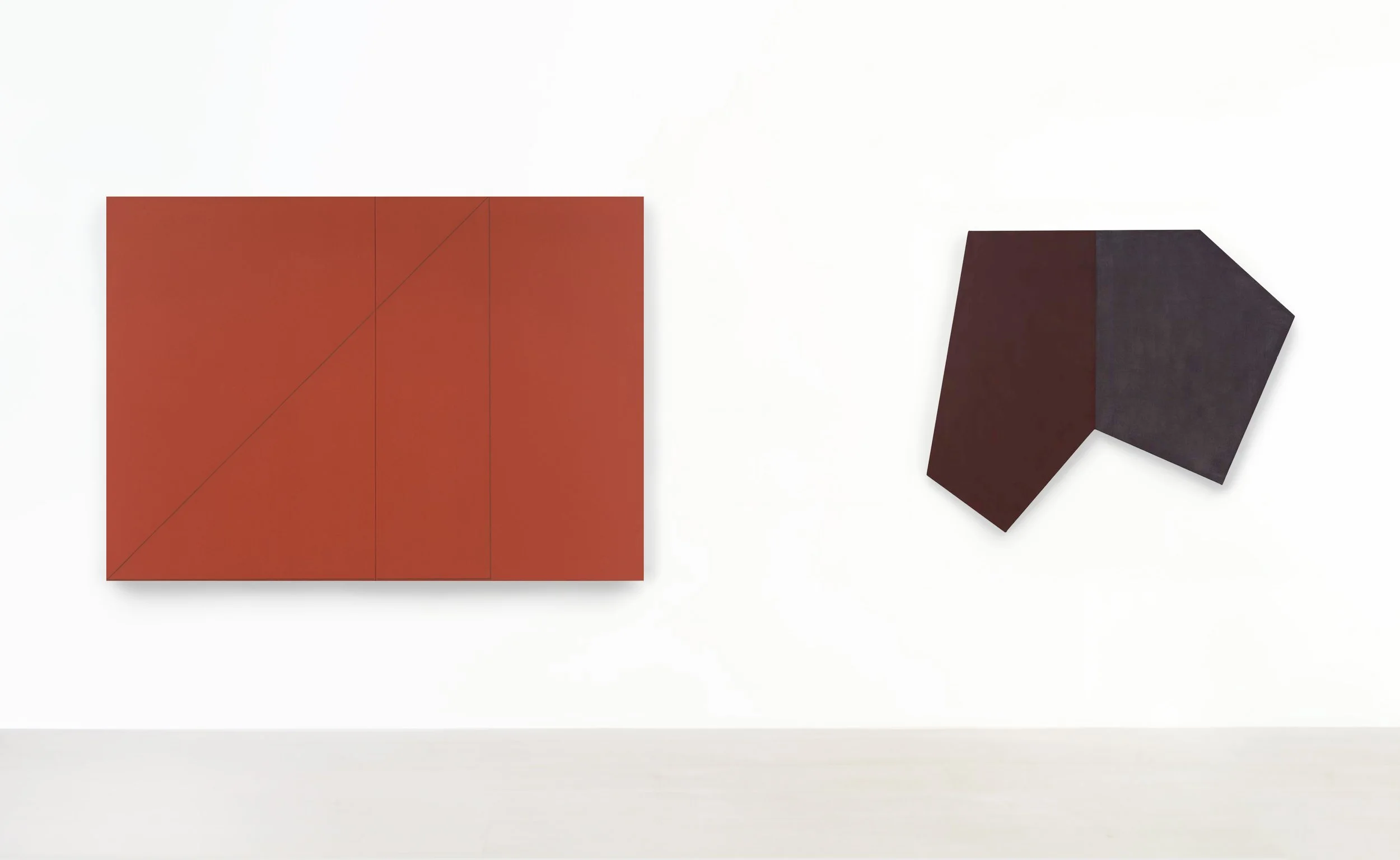
Despite their precision, Mangold’s paintings resist closure, remaining open to perception and interpretation. “The paintings… lead you,” he explained. “There’s a dialogue between you and the work.” This dialogue extends to the viewer, who encounters each painting as a set of conditions rather than a fixed image. Across this exhibition, a practice defined by restraint, repetition, and variation emerges: Mangold sets formal, spatial, and conceptual limits, then works against them, allowing each painting to reach its own resolution. His work exists neither as object nor window, but in an in-between space. As he puts it, “Continuity work is the only reasonable answer. Keep on thinking and looking.” Mangold continues to affirm the possibility of making great paintings, sustaining a relentless inquiry into what painting can hold and how it can evolve.
